Is your PC feeling a bit sluggish lately? A quick hardware boost can make your daily tasks feel smooth again. By choosing the right components, you can enjoy effortless multitasking and faster loading times without buying a whole new machine.
What I’ve noticed when upgrading RAM in real setups
In my experience, upgrading RAM is one of those changes that feels small but makes a noticeable difference in everyday use. I’ve worked with systems that seemed “slow” at first glance, but after adding more memory, tasks like switching between apps or opening heavy programs became much smoother. What stood out to me is that performance improvements often come from removing bottlenecks, not just adding power.
That said, I’ve also seen situations where people expected instant results without checking compatibility or installation details. Sometimes the issue isn’t the amount of RAM, but how it’s configured or whether it’s properly recognized by the system. A simple and practical habit is to double-check everything after installation, verify it in the BIOS, monitor usage for a few days, and avoid rushing into further upgrades. Taking a few extra minutes to confirm stability can save a lot of frustration later.
Whether you are a dedicated gamer or a creative professional, having enough computer memory is essential for modern software. This simple change can revitalize an aging system and give you the competitive edge you need. It is one of the most cost-effective ways to improve your user experience today.
Finding the perfect memory ram might seem tricky at first. Our guide will help you understand how to pick and install the best modules for your specific build. Let’s get your desktop running like a brand-new powerhouse with just a few simple steps.
Key Takeaways
- Enhance overall system speed for smoother multitasking.
- Revitalize older desktop computers with affordable hardware upgrades.
- Gain a significant competitive edge in modern gaming titles.
- Accelerate demanding workflows for professional creative design tasks.
- Simplify the hardware selection and installation process for your build.
- Optimize system stability while running multiple heavy applications.
Understanding the Role of Memory Ram in Your System
The role of Memory Ram in your system cannot be overstated, as it directly impacts multitasking and speed. Memory Ram acts as a temporary storage for data that the CPU uses to perform tasks, making it a crucial component for overall system performance.
As Jeff Hopper, a renowned computer hardware expert, once said, “RAM is the unsung hero of computer hardware. It’s not just about having a fast processor; it’s about having enough RAM to keep up with your workflow.” This emphasizes the importance of having sufficient and efficient Memory Ram for optimal system operation.
How RAM Impacts Multitasking and Speed
RAM significantly influences your system’s ability to multitask and its overall speed. With more RAM, your system can handle more applications simultaneously without a decrease in performance. This is particularly important for users who run multiple resource-intensive programs at the same time.
For instance, if you’re a gamer, having enough RAM ensures that your games run smoothly, even with multiple background applications open. Similarly, for professionals using creative software, ample RAM can significantly enhance productivity by allowing for smoother operation of demanding applications.
The Difference Between Volatile and Non-Volatile Memory
Understanding the difference between volatile and non-volatile memory is crucial for making informed decisions about your system’s memory needs. Volatile memory, such as RAM, loses its data when the power is turned off. In contrast, non-volatile memory retains its data even when the power is off.
This distinction is important because it highlights the role of RAM as a temporary workspace for your CPU. While non-volatile memory (like hard drives or SSDs) is used for long-term storage, RAM is used for short-term data that the CPU is currently processing.
Assessing Your Current Computer Memory Needs
Assessing your computer’s current memory capacity is the first step towards a successful memory upgrade. Understanding how much RAM your system currently has and whether it’s sufficient for your needs is crucial. This assessment will guide your decision on whether to upgrade and how much to upgrade.
Checking Your Current RAM Capacity in Windows
For Windows users, checking the current RAM capacity is straightforward. You can do this by opening the Task Manager and navigating to the Performance tab. Here, you’ll find detailed information about your system’s memory, including the total RAM installed and how much is currently in use.
To check your RAM capacity, press the Ctrl + Shift + Esc keys to open Task Manager. Then, click on the Performance tab and select Memory from the left sidebar. This will display a detailed overview of your system’s memory usage, including the total amount of RAM installed.
Determining if You Need More Memory for Your Workflow
Determining if you need more memory involves considering your workflow and the demands of the applications you use. If you frequently run multiple applications simultaneously or use memory-intensive software, you may benefit from a memory upgrade.
Consider your typical usage patterns. If you’re a gamer, video editor, or use other memory-intensive applications, you likely need more RAM. For general use like browsing and office work, your current RAM might be sufficient. However, if you notice your system slowing down when multitasking, it might be time to consider upgrading your laptop RAM.
Identifying Compatible Memory Modules for Your Motherboard
To ensure a seamless upgrade, it’s essential to determine the compatible memory modules for your motherboard. This involves a few critical steps that help you avoid compatibility issues and ensure that your system runs smoothly.
Consulting Your Motherboard Manual for Slot Specifications
The first step in identifying compatible memory modules is to consult your motherboard manual. The manual will provide you with detailed information about the type of RAM supported by your motherboard, such as DDR4 or DDR5, and the number of RAM slots available.
Key specifications to look for include:
- The type of RAM supported (e.g., DDR4, DDR5)
- The number of RAM slots available
- The maximum RAM capacity supported per slot
- Any specific requirements for dual-channel or quad-channel configurations
For example, if your motherboard supports DDR4 RAM, you should look for DDR4 modules that match the specified frequency and latency requirements.
Understanding Memory Frequency and Latency Requirements
Memory frequency and latency are crucial factors that affect your system’s performance. Memory frequency refers to the speed at which your RAM operates, measured in MHz. Latency refers to the delay between when the memory controller requests data from the RAM and when it is available.
Why Speed Matters for System Stability
Higher memory speeds can improve system performance, especially in applications that rely heavily on RAM. However, it’s essential to ensure that your motherboard supports the chosen RAM speed to avoid stability issues.
When selecting RAM, it’s also important to consider the CAS latency (CL) and other timings such as tRCD, tRP, and tRAS. These timings are usually represented as a series of numbers (e.g., CL16-18-18-36). Lower timings generally indicate better performance, but they must be supported by your motherboard.
To summarize, identifying the right memory modules involves checking your motherboard’s manual for supported RAM types and specifications, understanding the importance of memory frequency and latency, and ensuring that your chosen RAM is compatible with your system’s requirements.
Choosing Between DDR4 Ram and DDR5 Ram
When it comes to upgrading your PC’s memory, one of the most critical decisions is choosing between DDR4 RAM and DDR5 RAM. This decision is crucial as it directly impacts your system’s performance, efficiency, and future compatibility.
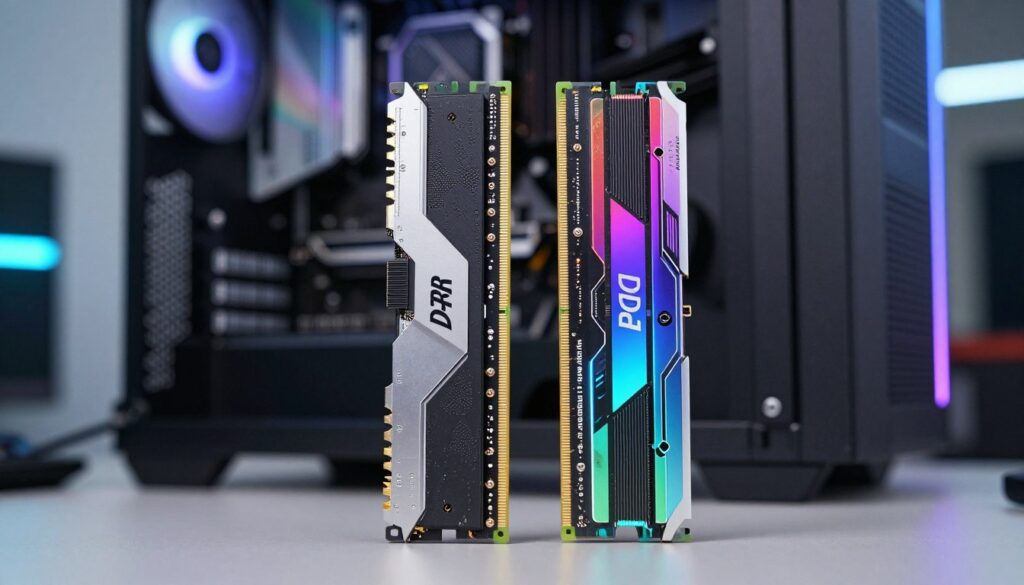
The primary factors to consider when deciding between DDR4 and DDR5 RAM include your motherboard’s compatibility and your specific performance needs. DDR5 RAM offers several significant improvements over DDR4, including higher speeds and better efficiency.
Evaluating the Performance Gap Between Generations
DDR5 RAM provides a substantial performance boost compared to DDR4. It offers higher data transfer rates, starting at 4800 MHz, and can reach speeds of up to 8400 MHz or more in some modules. In contrast, DDR4 RAM typically tops out at 3200 MHz for most consumer-grade modules.
Key Performance Differences:
- Speed: DDR5 RAM starts at 4800 MHz, while DDR4 tops out at 3200 MHz.
- Efficiency: DDR5 operates at a lower voltage (1.1V) compared to DDR4 (1.2V), reducing power consumption.
- Capacity: DDR5 modules are expected to support higher capacities per module.
Checking Motherboard Compatibility for DDR Standards
Before choosing between DDR4 and DDR5 RAM, it’s essential to check your motherboard’s compatibility. DDR5 RAM requires a motherboard with DDR5 support, as it is not backward compatible with DDR4 slots.
The Future-Proofing Benefits of DDR5
Opting for DDR5 RAM can be seen as a future-proofing strategy. As technology continues to evolve, DDR5 is expected to become the new standard, offering better performance and efficiency. Investing in DDR5 RAM now ensures that your system remains compatible with future upgrades and advancements.
| Feature | DDR4 RAM | DDR5 RAM |
|---|---|---|
| Speed (MHz) | Up to 3200 | 4800 – 8400+ |
| Operating Voltage (V) | 1.2 | 1.1 |
| Capacity per Module | Up to 32GB | Up to 64GB or more |
For users looking to upgrade their gaming PC or workstation with the best gaming ram or memory ram, understanding these differences is crucial. Whether you prioritize performance, efficiency, or future compatibility, making an informed decision between DDR4 and DDR5 RAM will significantly impact your system’s capabilities.
Selecting the Best Ram for Gaming and Productivity
For gamers and content creators, the importance of selecting the right RAM cannot be overstated, as it directly impacts system performance. The amount and type of RAM can significantly influence your computer’s ability to handle demanding tasks and applications.
Recommended Capacities for Modern Gaming
Modern games are becoming increasingly memory-intensive. At least 16GB of RAM is recommended for a smooth gaming experience. However, for heavy users or those who multitask, 32GB or more is becoming the standard. This ensures that your system can handle the game’s requirements along with any additional applications you might be running.
- For casual gamers, 16GB RAM is sufficient.
- For serious gamers and multitaskers, 32GB RAM is recommended.
- For extreme gaming and heavy multitasking, 64GB RAM or more can be beneficial.
Memory Requirements for Video Editing and Creative Software
Video editing and creative software also benefit significantly from ample RAM. 32GB or more is recommended for smooth performance, especially when working with high-resolution videos or complex projects. Applications like Adobe Premiere Pro, After Effects, and Photoshop can take full advantage of additional RAM, making your workflow more efficient.
- For basic video editing, 16GB RAM is a minimum, but 32GB is preferred.
- For advanced video editing and 3D modeling, 32GB RAM is a minimum.
- For professional video editing and complex projects, 64GB RAM or more is ideal.
Balancing Budget and Performance
While high-performance RAM can significantly enhance your system’s capabilities, it’s also important to balance your budget and performance needs. Consider your specific requirements and choose RAM that offers the best performance within your budget. It’s also worth considering future-proofing your system with higher capacity RAM to accommodate upcoming demands.
Preparing Your Workspace for a Memory Upgrade
To ensure a smooth and safe memory upgrade process, preparation is key. Upgrading your computer’s memory module or adding more laptop RAM can significantly enhance its performance, but it requires careful preparation to avoid any potential risks or damage to your components.
First, it’s crucial to understand the importance of a well-prepared workspace. A cluttered or poorly lit workspace can lead to accidents or mistakes during the upgrade process. Therefore, clearing a flat, stable surface and ensuring good lighting is the first step.
Gathering Necessary Tools and Safety Equipment
Before starting the upgrade, gather all the necessary tools and safety equipment. This typically includes a screwdriver (usually a Phillips head), an anti-static wrist strap, and the new memory module or laptop RAM you’ve purchased. Having everything within reach will make the process more efficient and reduce the risk of damaging your components due to unnecessary handling.
An anti-static wrist strap is particularly important as it prevents static electricity from damaging your computer’s internal components. Static discharge can occur if you touch the components without properly grounding yourself.
Preventing Static Discharge During Installation
Preventing static discharge is a critical step in the preparation process. Static electricity can easily damage sensitive electronic components. To prevent this, you can either touch a grounded metal object to discharge the static electricity from your body or wear an anti-static wrist strap connected to a grounded object.
Here’s a simple table summarizing the steps to prevent static discharge:
| Method | Description |
|---|---|
| Touching a Grounded Metal Object | Discharge static electricity by touching a metal object that is grounded. |
| Wearing an Anti-Static Wrist Strap | Wear an anti-static wrist strap connected to a grounded object to continuously discharge static electricity. |
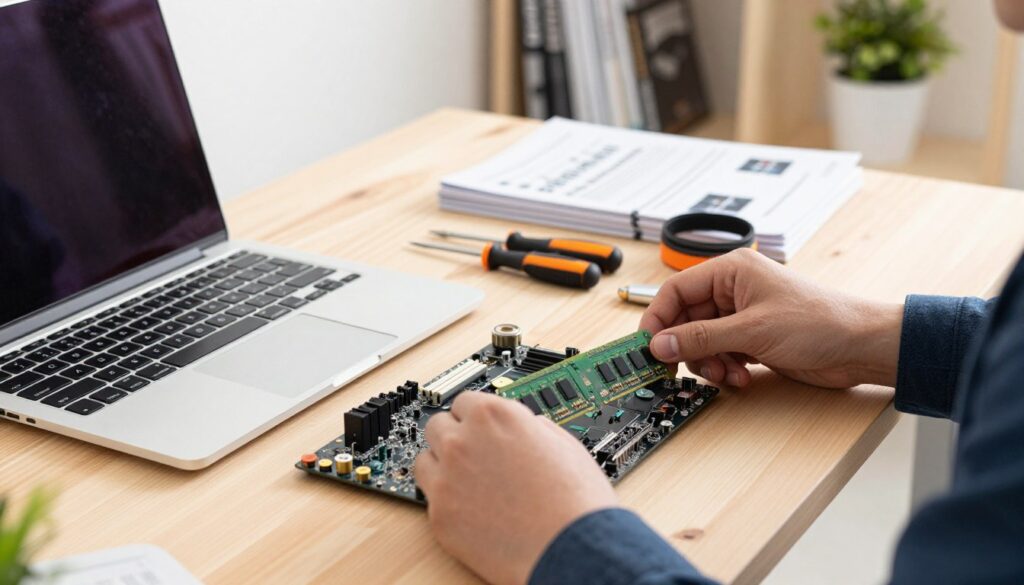
By following these steps and ensuring your workspace is properly prepared, you can significantly reduce the risk of damage to your computer’s components during the memory upgrade process.
Installing Your New Memory Ram Step by Step
With the right tools and a bit of patience, you can easily upgrade your PC’s memory and enjoy a smoother computing experience. This process involves several key steps that must be followed carefully to ensure a successful memory upgrade.
Powering Down and Opening Your PC Case
Before you start, make sure your PC is completely powered down and unplugged from the power source. This is a crucial safety precaution to prevent any damage to your components or injury to yourself. Once your PC is safely powered down, you can open your PC case to access the internal components.
Removing Old Memory Modules Safely
Locate the RAM slots on your motherboard and identify the old memory modules that need to be removed. To remove them, you’ll need to release the clips on the sides of the RAM slots. Gently push the clips outward, and the old RAM module will pop up. Carefully pull it out at an angle, taking note not to touch any of the electrical components.
Seating New RAM Sticks Correctly in the DIMM Slots
To install the new RAM, align the notches on the RAM stick with the tabs in the DIMM slot. Gently push the RAM stick into the slot at a 45-degree angle, and then secure it in place by applying gentle pressure until it clicks. Make sure it’s firmly seated and the clips on the sides are securely holding it in place.
Here’s a summary of the key steps and considerations for installing new RAM:
| Step | Description | Key Considerations |
|---|---|---|
| 1. Power Down | Completely power down your PC and unplug it. | Safety first to prevent damage or injury. |
| 2. Open PC Case | Access the internal components. | Ground yourself to prevent static discharge. |
| 3. Remove Old RAM | Release clips and gently pull out the old RAM. | Handle by the edges to avoid touching electrical components. |
| 4. Install New RAM | Align notches and secure the new RAM in place. | Ensure it’s firmly seated and clipped in. |
By following these steps carefully, you can successfully upgrade your PC’s memory with the best RAM for PC available, enhancing your computing experience.
Troubleshooting Common Issues After a Ram Upgrade
Upgrading your computer’s memory can sometimes lead to unexpected problems, such as boot failures or system instability. Ensuring that your new RAM is compatible and properly installed is crucial for a smooth operation.
What to Do If Your PC Fails to Boot
If your PC fails to boot after a RAM upgrade, the first step is to check that the RAM is properly seated in the DIMM slots. Make sure the notches on the RAM stick align with the tabs on the slot.
Compatibility is key: Ensure that your new RAM, whether it’s DDR4 RAM or the latest generation, is compatible with your motherboard. Check the motherboard manual or manufacturer’s website for specifications on supported RAM types and their frequencies.
If the issue persists, try removing the new RAM and test if your PC boots with the old configuration. This will help you determine if the new RAM is the cause of the problem.
Verifying RAM Recognition in the BIOS
After installing new RAM, it’s essential to verify that it’s recognized by the BIOS. Restart your PC and enter the BIOS settings (usually by pressing F2, F12, or DEL).
Look for the memory settings section to confirm that the new gaming RAM or any other RAM you’ve installed is detected. If it’s not recognized, save the changes and exit, then try reseating the RAM or checking for any BIOS updates.
Running Memory Diagnostics to Ensure Stability
To ensure that your new RAM is stable and functioning correctly, run a memory diagnostic test. Tools like MemTest86+ can stress test your RAM, identifying any potential issues.
Regularly checking your RAM’s health can prevent many issues and is a good maintenance practice for your PC. Running such tests can help you detect problems early on, ensuring system stability and preventing data corruption.
Conclusion
Upgrading your PC’s memory ram can significantly enhance its performance and capabilities, allowing for smoother multitasking, faster processing, and improved overall system efficiency. By understanding your memory needs, selecting the right type of RAM, and installing it correctly, you can breathe new life into your system.
A successful ram upgrade requires careful planning and execution. With the right memory ram, you can enjoy a more responsive and efficient computing experience, whether you’re gaming, creating content, or simply multitasking.
By following the steps outlined in this guide, you’re now equipped to make informed decisions and perform a successful ram upgrade, unlocking your PC’s full potential and taking your productivity to the next level.
FAQ
Why should I consider a memory ram upgrade for my current PC?
How can I tell if I need more computer memory for my daily tasks?
What is the main difference between ddr4 ram and the newer DDR5 standard?
How do I find the best ram for pc gaming and high-end streaming?
Can I install laptop ram in a desktop computer?
Is it difficult to install a new memory module myself?
What should I do if my PC doesn’t recognize the new memory upgrade?

is a hardware analyst and PC performance specialist. With years of experience stress-testing components and tuning setups, he relies on strict benchmarking data to cut through marketing fluff. From deep-diving into memory latency to testing 1% low bottlenecks, his goal is simple: helping you build smarter and get the most performance per dollar.